
Picture the AI lunch-and-learn. Good turnout, engaged questions, a demo that drew genuine murmurs. Everyone left saying we should really be using this more. Then Tuesday arrived with its deadlines, and by Friday the session might as well never have happened. Nobody was against it. Nothing changed. That gap between knowing and doing is where most employee AI training goes to die.
Here is the direct answer: AI training programs for employees work when they are designed to change behavior, not transfer information. That means three design choices: practice on the employee's own real work rather than demos, an accountability cadence that keeps practice alive after the session ends, and measurement that tracks changed workflows rather than attendance. Programs built this way produce visible results within weeks. Awareness sessions, however polished, produce agreement and nothing else.
The knowing-doing gap: why awareness sessions produce nothing
The knowing-doing gap is not a motivation problem, so motivational content cannot close it. Your employees already believe AI matters. Most have tried it. The gap exists because a webinar changes what people know, while their Monday morning is governed by what they habitually do, and habits do not update by exposure to information.
Three forces hold the old workflow in place. Deadlines: under pressure, everyone reverts to the method they trust, and the current way is proven while the new way is a gamble. Fuzziness: knowing AI can help with reports is not the same as knowing which report, starting with what prompt, checked in what way. And permission: many employees are quietly unsure whether serious AI use is encouraged, tolerated, or a career risk, so they keep it small and invisible.
Any program that does not address all three forces, pressure, fuzziness, and permission, will replay the lunch-and-learn at larger scale. This is the core test we describe in our guide on what to look for in an AI training program: ask the provider what participants will do differently on Monday, and see whether the answer is specific.
Design choice one: real work, not demos
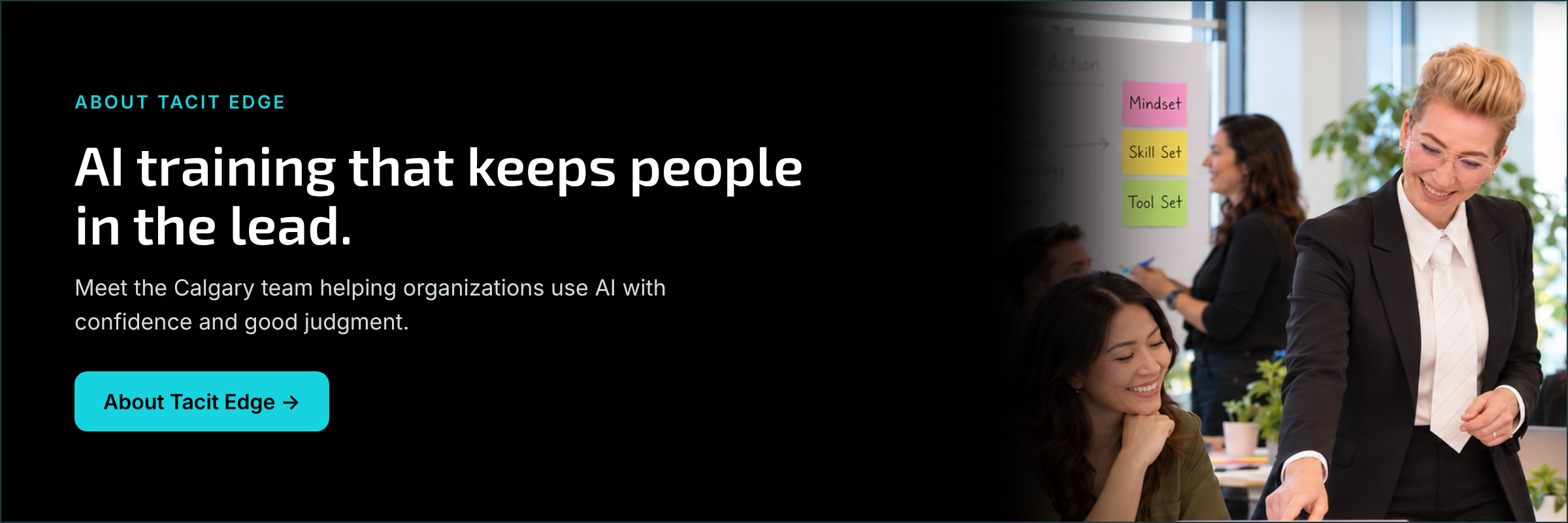
Every participant brings an actual task they own. The report they dread, the inbox routine that eats an hour daily, the process that always slips. The session is spent improving that task, so the training produces its first result before it ends. This single choice collapses the fuzziness problem: nobody has to translate a generic example into their own work, because they trained on their own work.
The win has to be felt, not promised. An employee who leaves a session having genuinely saved future hours on a task they hate needs no persuasion to continue. This is the design logic behind what an AI Kickstarter is: a compressed, build-something-real format where the proof arrives inside the room.
Teams train together so the norms change together. One trained individual returns to a team with unchanged habits and gets pulled back to the old normal. A whole team trained on shared work resets the normal itself. This is why we deliver AI Workshops for Businesses to intact teams rather than mixed audiences of strangers: behavior lives in groups.
Design choice two: an accountability cadence
The session is the start, not the deliverable. New workflows survive on rhythm: each participant leaves with a named commitment, a specific task they will run the new way. Two weeks later, the group reconvenes to compare results, debug what stalled, and set the next commitment. A visible scoreboard of wins keeps the momentum public.
Managers are the multiplier. A manager who asks what did you try this week in the team meeting does more for adoption than any follow-up email campaign. Good programs brief managers on exactly this role, because the cadence dies without them.
This cadence is also what makes expansion work. Once the pilot team's wins are visible, the next teams arrive curious instead of skeptical, and the internal proof does the selling. There is a reliable sequence for this, which we cover in our guide on how to implement ai training across teams without the resistance a mandate creates.
Design choice three: measure changed workflows, not attendance
Completion rates measure logistics. If you want to know whether AI training programs for employees are producing action, track behavior:
- Workflows changed: named tasks now done a new way, with the old way retired
- Hours returned: time savings on those tasks, reported by the people doing them
- Weekly active use on real work, across the team rather than just the enthusiasts
- Commitments kept: what share of session commitments actually got run
- Confidence before and after, because confident people keep experimenting when the program ends
Notice these are outcomes, not outputs. Prompts written and sessions attended are outputs. A Friday afternoon that no longer disappears into formatting is an outcome. Organizations that measure this way also discover which teams to invest in next, which turns training from an expense into a strategy. That shift is a large part of why AI training is becoming a competitive advantage: everyone can buy the tools, but the organizations converting knowledge into changed workflows are compounding while the rest hold meetings about potential.
Choosing AI training programs for employees: where to start
Start smaller than feels ambitious. One motivated team, real work, a cadence, and honest measurement will outperform an organization-wide awareness campaign every time. For teams that live in one primary tool, a focused entry point like our Chatgpt AI Training Course gets everyone to competent, confident daily use quickly, and the workshop and Kickstarter formats build from there.
Whatever provider you choose, apply the behavior test relentlessly: real work, cadence, measurement. Ask for evidence that past participants changed how they work, not just how they felt. The specifics in our Tacit Edge AI program reviews show what that evidence sounds like: people describing tasks they no longer do the old way. That is the sentence you are buying. Everything else is theatre.
Frequently asked questions about AI training programs for employees
How long before we see results?
With real-work practice, the first results arrive inside the first session, because participants improve an actual task on the spot. Team-level patterns, changed workflows and returned hours, typically become measurable within four to eight weeks of a cadence.
Should training be mandatory?
Make the pilot voluntary and the results public. Mandates fill seats with compliance; visible wins fill them with demand. By the second or third wave, the question usually inverts to when is it our turn.
What about employees who are anxious about AI?
Design for them, do not lecture them. Anxiety fades fastest when a person uses AI on their own work and discovers it removes the parts of the job they like least. Clear permission from leadership, what is encouraged, what the boundaries are, matters as much as the skills.
Our people already use ChatGPT casually. Do they still need training?
Casual use is usually shallow use: cleaning up emails while entire workflows sit untouched. Training moves people from using AI as a better thesaurus to redesigning how the work itself gets done, and that second step is where the returns live.
Your team already knows. Time to do.
Book a 20-minute consult and we will design an employee training path built on real work, a cadence that sticks, and results you can measure by the end of the first month.