
The demo was impressive. The rollout email was enthusiastic. Six months later, someone in finance is asking why the productivity numbers look exactly the way they did before the company started paying for AI. If you are living some version of that story, you are in very good company, and the explanation is more useful than the frustration.
Here is the direct answer: AI tools alone are not improving productivity because productivity does not live in software, it lives in how people work. Effective AI training for businesses closes that gap by building three things the tools cannot provide on their own: broad adoption across the team, workflows redesigned around the new capability, and shared judgment about when to trust the output. Buy the tools without building those three, and you have purchased potential rather than performance.
The productivity paradox, in plain terms
Economists have a name for what most businesses are experiencing right now: the productivity paradox. A transformative technology arrives, investment pours in, and measured productivity stays stubbornly flat for years, because the gains only show up once organizations reorganize the work around the technology. It happened with electricity, when factories spent decades bolting electric motors onto layouts designed for steam. It happened with computers. It is happening again with AI.
The pattern inside a company looks like this. A handful of enthusiasts use the tools constantly and rave about them. The majority try them once or twice, get a mediocre result, and quietly go back to their old habits. Usage that does persist stays shallow: tidying up emails, summarizing documents, drafting the occasional paragraph. Those are conveniences, not productivity gains. Nothing about how the team plans, produces, reviews, or ships has actually changed, so nothing changes in the numbers.
None of this means the investment was wrong. It means the investment was incomplete. The tools are the visible half of the system. The invisible half is human, and it is the half that determines whether anything improves.
What ai training for businesses actually has to solve
When we work with companies through Corporate AI Training, the presenting problem is almost always framed as a tools problem. It almost never is. Underneath, there are three human problems, and training has to address all of them.
The adoption problem. Most employees are not resisting AI because they doubt it works. They are hesitant because they are unsure what is allowed, worried about looking foolish, or convinced it is one more thing on an already full plate. Training solves this by making the boundaries explicit and giving people permission to learn out loud: to experiment, share rough attempts, and ask basic questions without penalty. Permission sounds soft. It is the single strongest predictor of whether adoption spreads beyond the enthusiasts.
The workflow problem. Using AI to do the old process slightly faster produces marginal gains. The real returns come from redesigning the process itself: collapsing steps, moving review to where it matters, letting AI carry the repetitive load while people carry the judgment. That is design work, and it starts with problems before solutions. Teams need to name what is actually slow, manual, or error-prone before anyone opens a chat window.
The judgment problem. When everyone invents their own rules about what data to share, what to verify, and what to trust, you get inconsistency at best and risk at worst. Training builds shared judgment: common standards for verification, common language for quality, common understanding of where a human must stay in the loop. Shared judgment is what makes speed safe.
Why the missing system is human, not technical
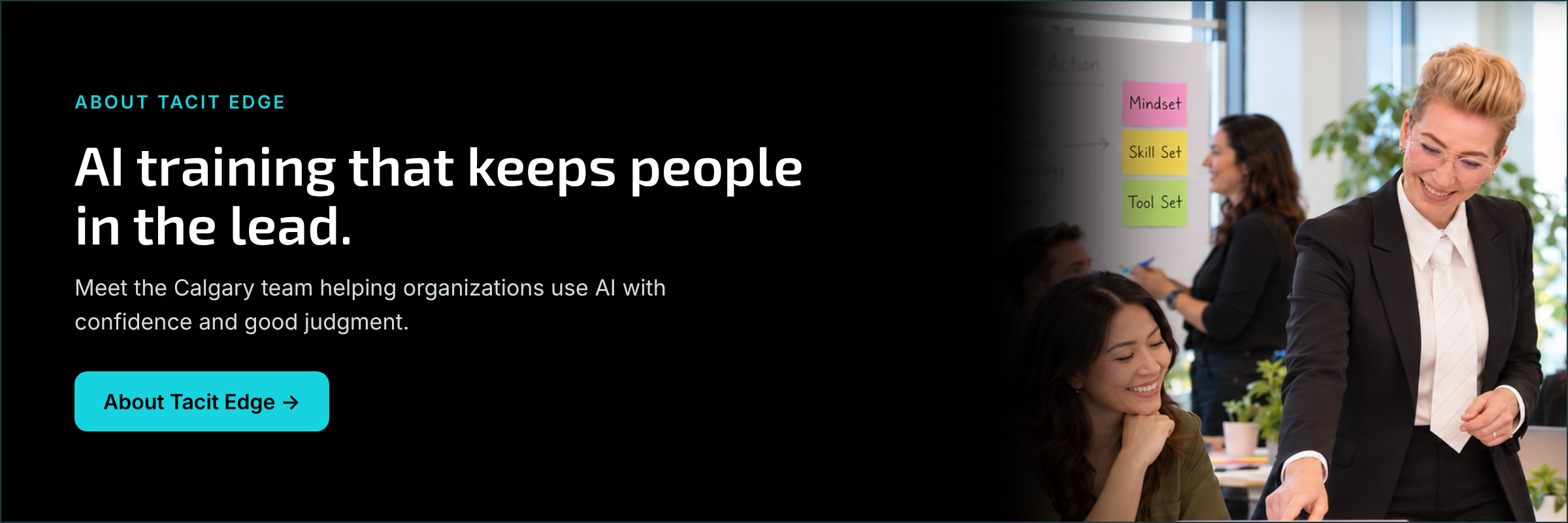
Our position at Tacit Edge is simple: you bring the tools, we bring the mindset and the skill set.
Mindset is how people relate to the technology: curiosity instead of fear, experimentation instead of perfectionism, ownership of outcomes instead of outputs. Skill set is the durable capability: framing problems, prompting with intent, verifying results, redesigning workflows. The tool set your company chose matters, but it is the layer that changes fastest and matters least. Businesses that invest in the first two layers keep their gains through every model update. Businesses that only train the buttons start over every quarter.
This is also why measurement has to change. Logins and license utilization are outputs. Hours returned on named workflows, processes rebuilt, and the percentage of the team using AI on real work every week are outcomes. Outcomes over outputs is not a slogan, it is the difference between a dashboard that looks busy and a business that runs better. We covered the broader evidence for this in our piece on ai training for organizations.
What effective ai training for businesses looks like
It starts with real work. Participants bring an actual task they dread, and they leave the first session with that task measurably improved. This is the fastest way to convert skeptics, and it is the core of what an AI Kickstarter is: a focused sprint where a team builds working improvements on their own workflows rather than watching demos of someone else's.
It trains intact teams. Behavior lives in groups, not individuals. When a whole team learns together through structured AI Workshops for Businesses, the norms of the group shift, and the change survives after the facilitator leaves.
It equips leaders to decide, not just approve. Leaders do not need to become technical, but they do need to weigh where AI will pay off and where it will not. There is a repeatable method for how to evaluate AI opportunities without technical experience, and leaders who learn it stop outsourcing their AI strategy to whoever sounds most confident in the room.
It sequences the rollout. Pilot with a motivated team, capture the wins, expand with proof. There is a reliable order of operations for how to implement ai training across teams without triggering the quiet resistance that a top-down mandate almost always creates.
The signals that tell you it is working
- Time savings reported on specific, named workflows, not vague estimates of feeling faster
- Adoption spreading beyond the early enthusiasts to the pragmatic middle of the team
- Processes that have been rebuilt, not just accelerated
- Better questions in meetings: people asking what to verify, not whether they are allowed
- Reclaimed hours flowing into higher-judgment work instead of more busywork
That last signal deserves attention. Judgment over speed is the long game. A team that saves four hours a week and spends them on client relationships, product quality, or thinking compounds its advantage. A team that saves four hours and absorbs them into noise plateaus exactly where it started.
Frequently asked questions about AI training for businesses
We already ran a lunch-and-learn. Why didn't it stick?
Awareness sessions inform, but they do not change behavior. Without practice on real work, feedback, and follow-through, people return to their desks and their habits within days. Training sticks when it is built around the participants' actual workflows.
How is business AI training different from letting people learn on their own?
Self-teaching produces uneven results concentrated in the already-motivated. Structured training produces shared standards, shared language, and adoption across the whole team, which is where business-level productivity actually comes from.
How quickly should we expect results?
A well-designed program produces a working improvement in the first session and visible team-level adoption within one to two months. If a provider asks you to wait a year to see anything, keep looking.
What should we look for in a training partner?
Ask whether they train on your real workflows, whether they address mindset and judgment rather than just tool features, and how they measure outcomes. If it helps your comparison, here is why choose Tacit Edge AI training as a starting point.
The tools were the easy part. Let's build the rest.
Book a 20-minute consult and we will map where the productivity gains are hiding in your workflows, and the fastest training path to reach them.